

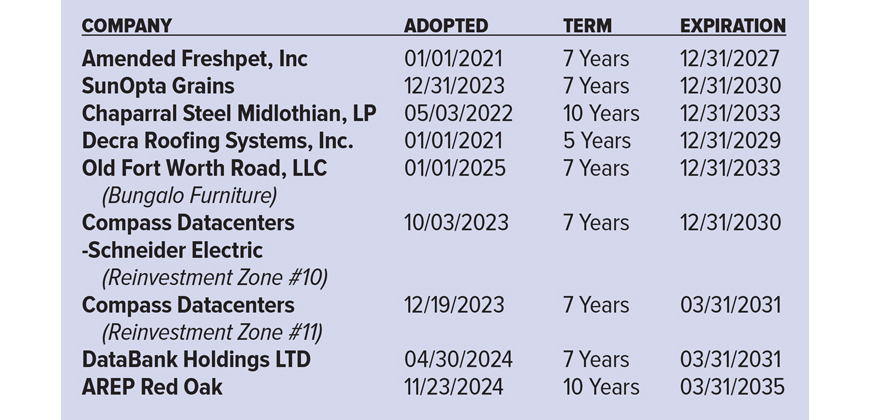
ELLIS COUNTY – An Ellis County reader requested an article outlining data center abatements in the county.
Ellis County is not responsible for abatements given to individual cities.
For example, if you are angry about a data center in Red Oak and abatements, your anger is misplaced if you direct it at the Judge John Wray and the county commissioners.
Judge Wray’s office sent me this information:
Regarding Weston Holladay:
“The Ellis County Commissioners Court approved a tax abatement agreement for Weston Holladay under the County’s recently updated, more conservative guidelines.
The terms approved by the Court were significantly more conservative than those requested by Weston Holladay,” Wray said.
That company ultimately chose not to accept or execute the agreement.
As a result, the agreement never went into effect, and Weston Holladay does not have an active tax abatement agreement with Ellis County.”
Wray added, “The various cities [in Ellis County] may have other/different tax abatement agreements they have entered into with property owners.
“Whether the cities enter into such agreements and the terms of the agreements are entirely up to the cities. The county has no control over these decisions.”
Wray also pointed out the opportunity to apply for a tax abatement in Ellis County for Data Centers is always available.
“However, each application is considered individually,” he said.
“The specific request, whether it meets the required criteria, and other relevant factors will ultimately determine whether the Commissioners Court chooses to approve or deny the abatement.”
In November 2025, Ellis County adopted an updated tax abatement policy that reflects a more conservative approach to these incentives, including significantly reducing the maximum amounts and lengths of abatements that may be considered.
Tax abatements are generally intended to serve as an economic development tool to help attract projects that may be considering multiple locations.
Ellis County already maintains one of the lower property tax rates in Texas and continues to experience significant growth without relying heavily on tax abatements as an incentive.
“Businesses continue to locate and expand in Ellis County without requesting abatements. With that growth already occurring, there has been less need in recent years for the County to use tax abatements as an incentive to attract development,” Wray added.
Red Oak and Midlothian also have tax abatements located in Ellis County.
Primarily originated from Yahoo Finance and The Dallas Morning News from real estate market coverage, it was reported that Red Oak is a central hub for the local buildout, currently hosting seven data center sites at various stages of development.
The Compass Datacenters Deal (May 2026) approved by the Red Oak City Council 4-1 approved a massive zoning change and local tax abatement package for an 830-acre campus representing a $9.45 billion investment.
The application for the county-level portion of the abatement was withdrawn in June 2026 amid significant resident protests. The municipal-level incentives are structured to eventually add $405 million back to the local tax base once the initial abatement periods conclude.
Other major players in Red Oak include Google and DataBank, which hold long-term property tax abatements to expand their digital footprints in the city.
Midlothian was one of the earliest Ellis County cities to heavily incentivize hyperscale data center facilities.
The Google “Sharka” Project (2018–2019) originally operated under the secret shell name “Sharka,” and Google brokered the deal for a $500 million facility at the RailPort Business Park.
The Midlothian City Council approved a 100% personal property tax abatement alongside an 85% improvement property tax abatement over a 10-year timeline. Total local municipal tax breaks for this initial phase exceeded $10 million.
That information when researched came from facts regarding tax structures from the Midlothian City Council minutes and planning documents. Local economic agreements are filed under Chapter 312 of the Texas Tax Code, and records maintained by the Texas Comptroller’s Office formally track Sharka LLC as the property owner.
The “Sharka” shell-company strategy was also heavily described in an investigative report by The Washington Post and syndicated in the LA Times and academic briefs by Stanford Law.
These publications investigated how tech monopolies like Google utilized Delaware-registered LLCs to negotiate municipal tax breaks quietly.
It was reported since the 2018 deal, Google’s footprint at the Midlothian RailPort campus has scaled into a much larger, multi-phase digital hub, with its fifth building expansion permitted for construction.