
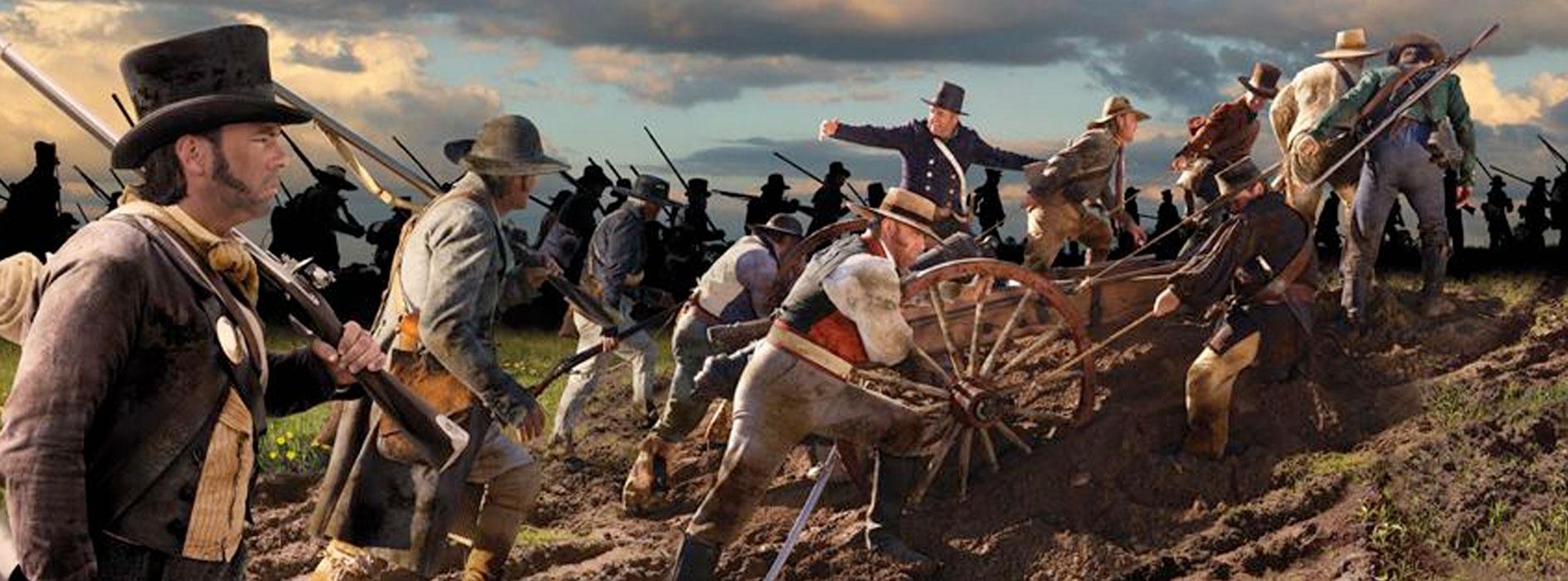
Tensions had been simmering between rebellious Texans and Mexico.
Settlers from the United States had been moving to Texas (then a part of Mexico) since 1825 with the support of the Mexican government, but a number of factors made them unhappy, and open war broke out at the Battle of Gonzales on October 2, 1835.
Mexican President/General Antonio Lopez de Santa Anna, who proclaimed himself the “Napoleon of the West,” marched north with an army of over 6,000 seasoned troops to crush the rebellion, crossing the Rio Grande on February 16, 1836.
After a 13-day siege, his troops overwhelmed the defenders of the Alamo on March 6, 1836, slaughtering the entire garrison. That was followed by the Goliad Massacre on Palm Sunday, March 27, in which 445 Texan prisoners of war were marched out of Presidio La Bahia in 3 groups and executed.
After the news of the slaughter at the Alamo and Goliad, Texas settlers fled from the advancing Mexican army eastward in what is now called the “Runaway Scrape” fearing for their lives.
Santa Anna believed that the Texans were beaten – even though General Sam Houston still had an army of almost 800 in the field.
Houston was able to keep one step ahead of Santa Anna. His critics called him a coward, but Houston felt he would only get one shot at defeating the much-larger Mexican force, and preferred to pick the time and place for battle.
In April of 1836, Santa Anna learned that Houston was near present-day Hempstead. He divided his army in three: one part went on a failed attempt to capture the provisional government at Harrisburgh, another remained to protect his supply lines, and the third, numbering more than 700 men – which he commanded himself – went after Houston and the Texan army.
When Houston learned what Santa Anna had done, he knew the time was right – and turned to meet the enemy.
Houston’s army reached Lynch’s Ferry mid-morning on April 20. The Texans made camp in a wooded area along the banks of Buffalo Bayou; while the location provided good cover and helped hide their full strength, it also left the Texans no room for retreat.
Santa Anna’s force arrived a few hours later. Over the protests of his officers, Santa Anna chose to make camp in a vulnerable location, a prairie near the San Jacinto River, bordered by woods on one side, a marsh and Peggy’s Lake (named after Peggy McCormick, the owner of the property) on another.
The two camps were approximately 500 yards apart, separated by a grassy area with a slight rise in the middle.
On the afternoon of April 20, Colonel Sidney Sherman demanded that Houston send a cavalry charge to attack the Mexicans: Houston thought this foolish. Sherman rounded up 60 horsemen and charged anyway.
The Mexicans did not flinch and before long, the cavalrymen were trapped. Over Houston’s objections, Texan infantrymen rushed onto the field, allowing the horsemen to escape. Houston was irate that the infantry had disobeyed his orders and given Santa Anna a better estimate of their strength; the men were equally upset that Houston had not allowed a full battle.
Throughout that night, Mexican troops worked without sleep to fortify their camp, creating breastworks out of trunks, baggage, saddles and brush.
On the morning of April 21, Santa Anna received 540 reinforcements under the command of General Martín Perfecto de Cos, bringing the Mexican force to around 1,500 men.
When no attack by Houston came that morning, Santa Anna lowered his guard and allowed his exhausted troops to rest, eat and bathe. The troops under Cos were particularly tired, having marched for more than 24-hours with no rest or food.
Not long after Cos arrived, Houston ordered Erastus “Deaf” Smith to destroy Vince’s Bridge (located 8 miles from the Texan encampment) to block the only road out of the Brazos and, thereby, prevent any possibility of escape by Santa Anna.
Shortly before noon, Houston held a council of war – and decided to attack. Around 3:30 p.m., the army quietly wheeled its two “Twin Sisters” cannons, a gift from the people of Gonzales, onto the prairie. And then in a thin line 1,000 yards across, infantry, cavalry and the two canons began to cautiously advance through the tall grass, hidden from Mexican view by trees and the rise.
200 yards from Santa Anna’s camp, the Texans realized their foe was unaware. Santa Anna had failed to set pickets out. They were attacking during the Mexican army’s siesta.
At that moment the Sisters opened fire, sending chopped horseshoes, musket balls and broken glass slashing into dozing Mexican soldiers.
The Mexican camp erupted into chaos, with startled soldiers scrambling for their stacked weapons, others trying to shelter themselves behind large trees. Still others hunkered down to the ground, trying to avoid the rain of deadly grapeshot.
After a single point-blank volley of musket fire, the Texan infantry charged, screaming “Remember the Alamo! Remember Goliad!” The incensed troops plowed through the breastworks and into the startled Mexican soldiers, fighting hand-to-hand using their rifles as clubs and slashing with tomahawks and Bowie knives.
Mexican officers yelled orders attempting to organize their men into some form of defense, but any organized resistance was viciously mowed down.
Deaf Smith was heard shouting above the fray, “Take prisoners like the Mexicans do!”
The main battle was over in just 18 minutes – but the killing went on until after dark.
Many Texan officers, including Houston, attempted to stop the slaughter, but they were unable to gain control of their men – who were bent on revenge.
Screaming “Me no Alamo,” Mexican soldiers clutched at Texan ankles and begged for their lives – to no avail.
Panic-stricken soldiers ran for their lives back along the bayou and the prairie, with vengeful Texans right on their heels clubbing or shooting or hacking them to death.
Those who made it alive to Peggy’s Lake jumped in to escape – only to be picked off like sitting ducks in the water. It was said so many bodies piled up in the lake that it was possible to walk across it.
When it was finally over, 630 Mexicans soldiers lay dead on the field, with 208 wounded and more than 730 captured.
Eleven Texans were killed, with 30 others, including Houston, wounded.
Houston had three horses shot out from under him and had his left ankle shattered by a musket ball. As the afternoon turned to evening, the Texans led columns of Mexican prisoners into camp – but there was no sign of Santa Anna.
Early the next day, a Texan detail in search of additional prisoners discovered him hiding in tall grass. Dirty and wet, he was wearing a Mexican private’s blouse, but Mexican prisoners recognized him as he was led to where the wounded Texas general was lying at the base of a large live oak, in considerable pain from his ankle. “El Presidente!” they gasped as the dictator passed by.
Many of the victorious Texans clamored for Santa Anna’s execution.
Houston wisely refrained – he knew Santa Anna was worth much more alive than dead. There were still three large Mexican armies in Texas, under Generals Filisola, Urrea and Gaona: any one of them was large enough to potentially defeat Houston and his men.
After being held for three weeks as a prisoner of war, Santa Anna signed the peace treaty that dictated that the Mexican armies leave the region, paving the way for the Republic of Texas to become an independent country.
- Log in or Subscribe to post comments.