
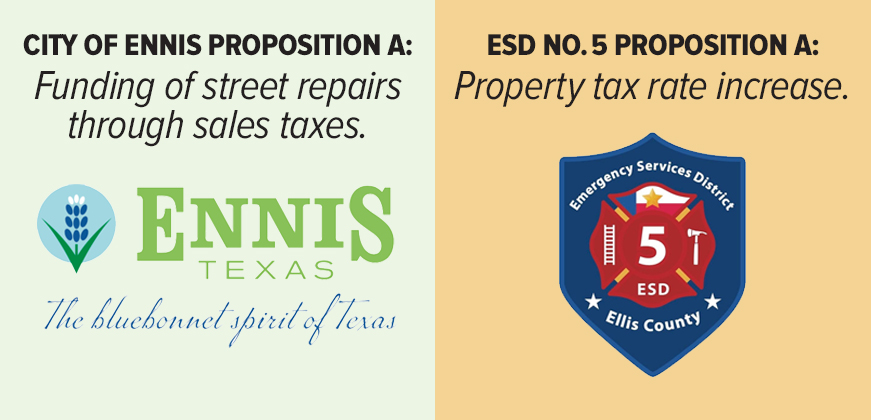
ELLIS COUNTY – For voters in November’s midterms, certain ballots will being asking two very different tax questions.
One item for Ennis concerns funding of street repairs through sales taxes.
The second item is to give a local emergency services district the authority to levy a substantially higher property-tax rate.
Proposition A for Ennis asks voters to reauthorize the local sales and use tax at a rate of 0.0025 for municipal street maintenance and repair.
If approved, it would continue for another four years before requiring reauthorization again.
According to Ennis’ city website voters first approved this tax in November 2014 and have reauthorized it twice.
It also explains the reauthorization would not raise the tax rate.
The combined city sales and use tax rate would stay at 2.0 percent, including portions dedicated to economic development and to crime control and prevention.
The tax is scheduled to expire March 31, 2027, if voters do not reauthorize it.
The total city local rate would be reduced to 1.75%.
Since collections began in April 2015, the tax has generated more than $13.9 million, including $1.47 million in Fiscal Year 2025-2026.
Those funds paid for base stabilization and surface repairs on 15 streets. City staff say additional streets remain in need of repair.
Also on the ballot is a property-tax rate proposition for Ellis County Emergency Services District No. 5.
The tax increase authorization asks voters to authorize an increase in the district’s maximum property-tax rate from $0.03 per $100 of taxable value to no more than $0.10 per $100.
The official ballot labels this a tax increase.
One distinction is voters would be authorizing a higher ceiling.
Approval would not, by itself, mean the district must immediately adopt the full 10-cent rate.
The district says the current three-cent cap has constrained its ability to respond to population growth, rising equipment costs and increased emergency calls.
It states the district receives funding from property owners in both Ellis County and Ferris.
There have been several needs identified including staffing additional paid firefighters and supporting volunteer personnel, replacing and upgrading firefighting equipment and apparatus, expanding service capacity as the population and number of calls increase and improving the district’s ability to protect residents, potentially helping improve its Insurance Services Office rating, which can affect homeowners’ insurance costs.