
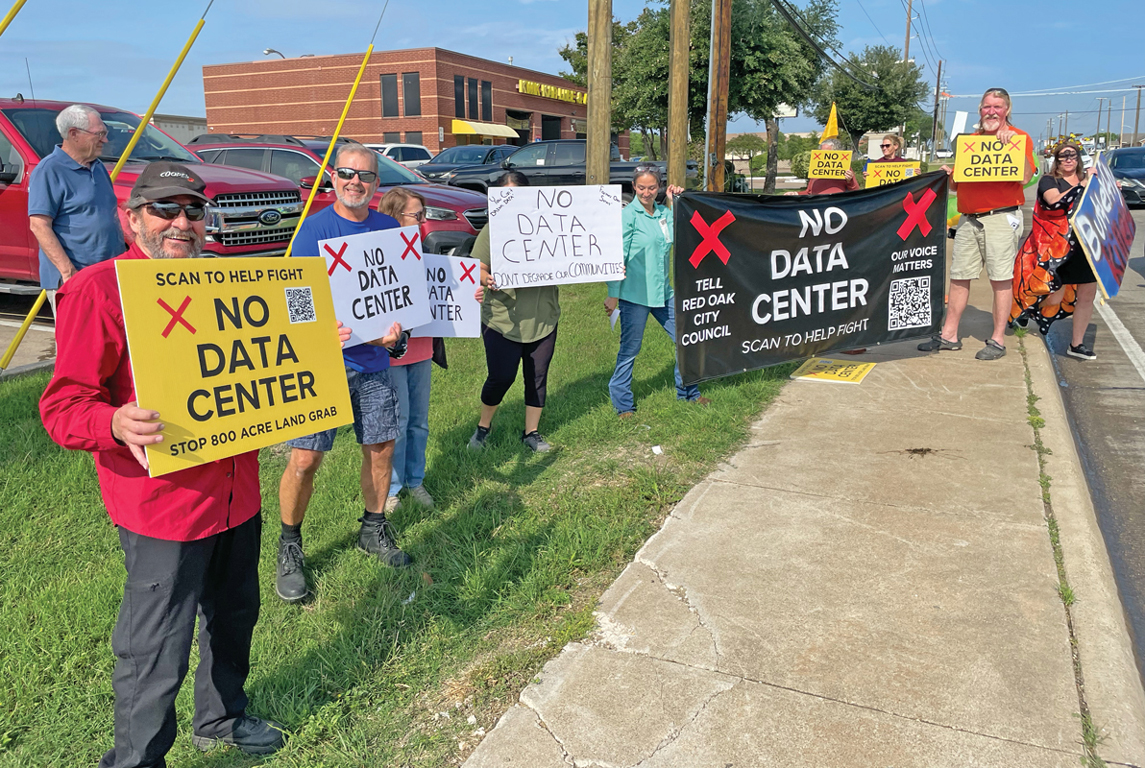
RED OAK – What began as a local fight over an 830-acre agricultural tract in Red Oak has escalated into an Ellis County lawsuit and a high-stakes gubernatorial campaign debate over the future of Texas infrastructure.
The controversy centers on a formal lawsuit filed in Ellis County by two local residents against the City of Red Oak, its mayor, and five city council members (www.elliscountypress.com/news/lawsuit-targets-red-oak-data-center-rezoning). The legal challenge seeks to invalidate a municipal ordinance passed in May that rezoned agricultural land to accommodate a massive, 900-megawatt hyperscale data center campus.
The plaintiffs allege that elected officials and municipal staff failed to comply with mandatory Texas voting, notice, and procedural laws. The lawsuit follows a contentious public meeting where hundreds of area residents arrived to protest the proposal before the council ultimately voted to approve the project.
This local friction has drawn bipartisan concern regarding industrial expansion.
On Thursday, Sept. 3, Texas gubernatorial candidate Gina Hinojosa held a press conference in Red Oak. She publicly condemned the rapid expansion of seven planned North Texas data centers, citing severe industrial strain on localized water supplies, noise levels, and the state power grid. Hinojosa advocated for stronger localized zoning protections to insulate rural and suburban communities from heavy utility demands.
The political intervention highlights a major legislative disagreement between Hinojosa and incumbent Governor Greg Abbott regarding state-level oversight.
The Abbott administration has already enacted several regulatory measures through executive directives.
On Aug. 3, Abbott ordered the Public Utility Commission of Texas (PUCT) and ERCOT to freeze all approvals for new data center grid connections. He also mandated a comprehensive state audit to address non-compliance among tech companies failing to report water consumption, grid strain, and tax-break allocations.
On Aug. 18, Abbott supplemented the directive by announcing mandatory statewide standards requiring data centers to fund their own infrastructure, implement water recycling systems, and avoid residential disruption.
Hinojosa counters that executive actions are insufficient to protect municipalities like Red Oak, which approved its rezoning prior to Abbott’s August freeze. She is calling for an emergency special legislative session to pass permanent, legally binding statewide zoning laws and fully repeal the corporate tax incentives that initially attracted tech operations to the state.
However, a special legislative session means an estimated cost of $2 million to $3 million for Texas taxpayers, requiring a daily per diem of $221 for each of the state’s 181 lawmakers.
Because the 90th Texas Legislative Session is already scheduled to convene on Jan. 12, 2027, the necessity of a special session remains heavily debated.
Proponents argue that waiting until January poses an immediate risk to local communities, noting that standard bills take months to pass and typically do not take effect until September 2027.
Conversely, state leadership maintains that the immediate grid emergency is mitigated by the active regulatory freeze.
Amid the political debate, data transparency remains a critical issue for local regulators. Recent state metrics revealed that only 30% of operating data centers responded to the state-mandated water usage inquiry, raising ongoing questions regarding compliance and local enforcement capabilities.
The legal dispute over the Red Oak campus risks reducing a serious community crisis into a political campaign backdrop rather than addressing the urgent needs of local residents.
State leaders clashing over regulatory proposals for votes ultimately risks overshadowing local control efforts with high-stakes political theater and undermines the serious issues that Red Oak residents are facing on the ground.