
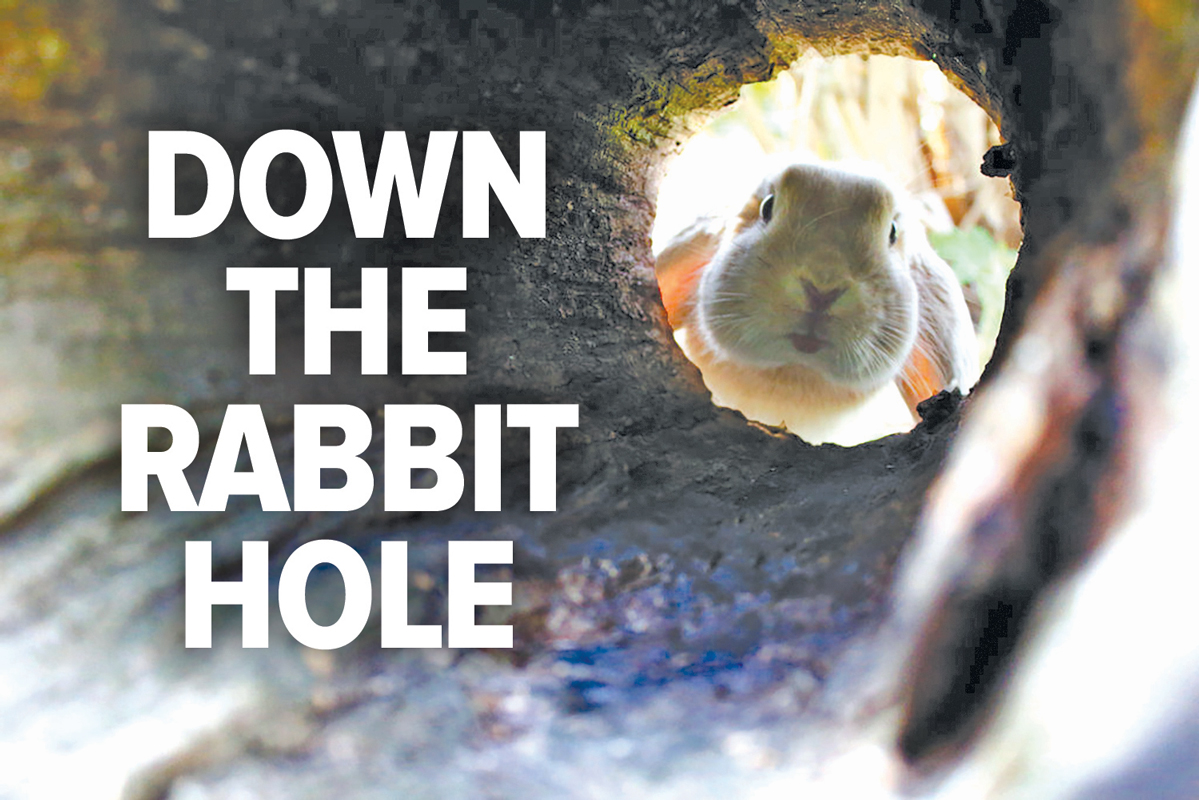
I went down the human cloning rabbit hole tonight.
Quite the bipartisan issue I would say.
The entire train of thought began with me being flabbergasted by people who are either “too arrogant” or “something worse” and therefore don’t know to keep their mouth shut before acquiring all the facts on a matter.
My mind then drifted to “I bet clones would act like that too.”
Then I fell hard down the cloning rabbit hole and learned a thing or two.
First, as to how my mind works, I do believe some of the more preposterous things I hear often turn out to be true.
Then, the things I don’t believe that I hear sometimes also turn out to be true.
In short: anything is possible.
Like the accurate cloning information that I uncovered.
I realized that we, as a species, are not close – we are already there with the ability to clone – HUMANS.
Geez – when I read that I closed my eyes and sighed thinking “for crying out loud” please don’t clone certain people since they are already annoying enough.
From my research I learned “no human being has ever been fully cloned.”
Or at least not really, supposedly.
Is it obvious I’m skeptical?
One reason is because I read that “reproductive human cloning remains globally banned, scientifically hazardous, and ethically condemned.”
Red flag because how can something be banned if it does not exist.
So further down the rabbit I fell.
What is the reality of biological human cloning?
Scientists have successfully cloned various mammals.
Researchers have successfully used Somatic Cell Nuclear Transfer (SCNT) to clone human blastocysts (early-stage embryos) strictly for therapeutic cloning, the extraction of stem cells to treat diseases.
For instance, fertility specialist Samuel H. Wood cloned his own cells into embryos for research in 2008.
That information was followed up by the fact that no embryo has ever “been allowed” to develop into a baby.
The words “been allowed” proves it can be done.
There were also the red flags when I read that “Reproductive human cloning faces near-universal opposition due to a combination of international treaties, national laws, and foundational bioethical principles.”
Again, why do we need international treaties, laws and bioethical principles if it can’t be done.
Well, it can be – and in the dark dungeons and back rooms, do you think it is being done?
International prohibitions include the UN General Assembly adopting the Declaration on Human Cloning, calling on member states to prohibit all forms of human cloning that are incompatible with human dignity.
The European Union has explicitly banned reproductive cloning under Article 3, asserting that every human being has a right to genetic uniqueness.
The World Health Organization maintains that human reproductive cloning is ethically unacceptable and poses grave threats to safety.
You would not think living, breathing “humans” with a brain would actually need to be told that cloning should be a no-no.
Reportedly, animal cloning reveals severe risks, including Large Offspring Syndrome, organ failure, and premature death. Therefore, attempting this on humans violates the bioethical rule of non-maleficence.
Ethicists argue that a clone could face severe psychological distress, struggling with a compromised sense of identity and the burden of living out a predetermined genetic path.
Regulators fear that permitting reproductive cloning would inevitably lead to genetic enhancement, creating a societal divide based on manufactured genetic traits.
In 2013, researchers at the Oregon Health & Science University successfully took a human skin cell, fused it with a donated human egg (which had its own DNA removed), and triggered it to grow into a human embryo. Scientists voluntarily stopped the experiment after a few days after they extracted stem cells. However, that embryo was a genetic clone of the skin cell donor. If that embryo had been implanted into a surrogate mother, it theoretically could have grown into a cloned human baby.
The fear is too of scientists possibly ignoring global ethics like in 2018 when Chinese scientist He Jiankui shocked the world when he created the world’s first genetically modified babies (twin girls named Lulu and Nana) using CRISPR gene-editing technology.
Of course, his work was met with outrage, but he did it and that’s what I’m talking about here.
Let’s face it, if a team of rogue scientists with tens of millions of dollars set up a secret laboratory in a country with no regulations or extradition laws, they could theoretically attempt to clone a human today.
There are types of cloning that are available and not outlawed like pet cloning, so let’s face it folks, it is just a matter of time.
ViaGen Pets (viagenpets.com) is a Texas-based company creating genetic twins of dogs, cats, and horses. The dog and cat cloning starts at $50,000 and you get your money back if a healthy animal is not delivered.
As I think about this, I can see an ad in maybe five years that you get your money back if a healthy grandma (or fill in the blank) is not delivered.
They do admit to one snafu, “A cloned pet is not reincarnation.” Well no kidding Sherlock.
There is also digital cloning, and when I looked up https://eternity.ac I thought it could be a joke – but the joke was on me.
This type of cloning in the digital space refers to creating an interactive, artificial intelligence-driven copy of a person’s likeness, voice, and personality. Eternity AC is an AI platform that builds “digital twins” intended to preserve a person’s legacy. It utilizes a person’s voice and all you do is answer 25 biographical questions, and upload selfies. The platform then processes this data into a talking 3D avatar that can converse with family members, fans, or clients long after the user is gone.
If it gives you any solace The Dickey-Wicker Amendment passed by Congress annually since 1996 is a federal law explicitly prohibiting the Department of Health and Human Services (HHS) and the National Institutes of Health (NIH) from using federal taxpayer dollars to create human embryos for research purposes or to destroy human embryos.
The U.S. Food and Drug Administration (FDA) maintains strict jurisdiction over clinical research involving human cloning and said any attempt to clone a human being requires their explicit authorization, and the agency will not grant it due to severe safety and health risks.
And there are also state laws beyond federal funding restrictions with at least 15 U.S. states having passed laws that completely ban reproductive human cloning, making it a criminal offense. So, at least there are “some” restrictions in place.
And bringing this all around, perhaps someday that likeness of you, Fido, Fluffy, or even grandmama will be stored in that data center they are building right next to your home. Stranger things have happened, and as William Shakespeare’s Macbeth and Ray Bradbury remind us, “Something wicked this way comes.”
It seems to be coming quickly. So, as we stand on the edge of this brave new world, the real question isn’t whether science can create a double of you – it’s whether humanity is ready to live alongside it.
Rita Cook is a freelance writer for The Ellis County Press. She can be reached at rcook13@earthlink.net.