
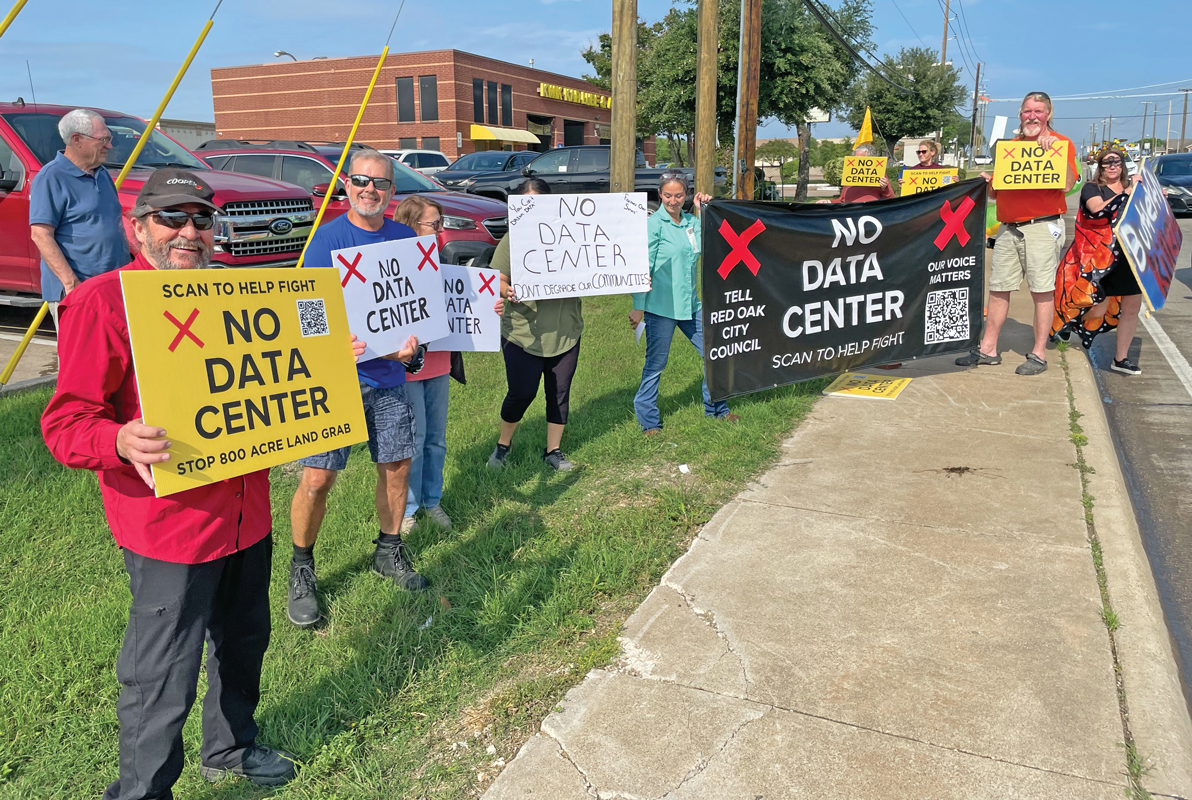
RED OAK – More than 100 people attended last Monday night’s nearly 5-hour meeting to oppose the rezoning of an 830-acre property from agricultural district to allow a data center campus to be built.
The tension between preserving a slower, quieter way of life and embracing a high-tech future with promises of economic prosperity was on full display’
Council members voted 4-1 for rezoning nearly 830 acres from agricultural district to planned development for a “high tech industrial park,” which city officials said would be “conducive to data center uses.”
“We are not opposed to data centers,” Red Oak resident Cindi Stephenson said to City Council members during public comment. “We’re opposed to the city putting them in our neighborhoods and our homesteads. … None of you have them in your backyard. Why should they be in my backyard?
“Don’t let Google decide who you trust.
“You might as well call it Data Center, Texas,” she added.
Council members Mayor Pro Tem Willie Franklin Jr., Sean Flannery, Ricardo Miller and Tim Lightfoot voted in favor of the rezoning, and Jeffery Smith voted against it.
Mayor Mark Stanfill didn’t have a vote.
The request was submitted by the Red Oak Industrial Development Corp., a group that acts as “the sales tax arm of the city” to bring in industry and business.
The council also voted 4-1 to approve a tax abatement for the project.
Smith, again, was the lone opposing vote.
The city has a few data centers either already operating or being constructed by companies including Google, Dallas-headquartered DataBank and Compass Datacenters. The 830-acre property at the center of Monday’s meeting is under contract by Compass for a proposed second campus within the city.
City Manager Todd Fuller explained the center will use a closed-loop cooling system, which would require 10-million gallons of water annually, an amount he said is less than an average Walmart Supercenter that uses closer to 15-million gallons annually.
More than 20 people spoke during the public comment portion, ranging from decades-long residents to people who had purchased a home as recently as a few weeks ago. All of them opposed the rezoning.
Residents raised other concerns, including the proposed data center’s effects on people’s health of living so close to one, constant noise, light pollution, increased traffic, disturbances from construction, lower property values, and more frequent flooding because of the concrete infrastructure.
Monday’s vote comes just two weeks after the city’s planning and zoning board voted 3-2 to not recommend the rezoning on April 27.
Several homeowners living in the unincorporated Ellis County said they weren’t notified by the city of the potential rezoning despite their property being hundreds of feet from the potential new data center.