
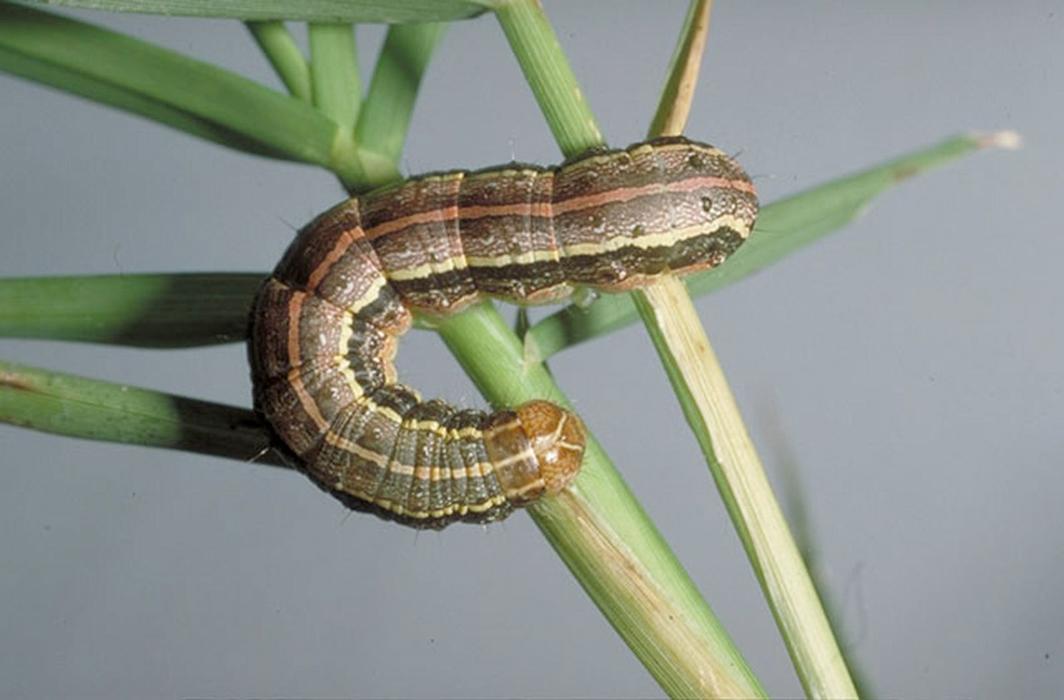
With our current climate conditions, producers need to be on the lookout for fall armyworm infestations in their fields.
The fall armyworm, Spodoptera frugiperda, is a common pest of bermudagrass, sorghum, corn, wheat and ryegrass and many other crops in north and central Texas.
Larvae of fall armyworms are green, brown and black with white to yellowish lines running from head to tail.
A distinct white line between the eyes forms an inverted “Y” pattern on the face.
Four black spots aligned in a square on the top of the segment near the back end of the caterpillar are also characteristic of fall army worm.
Army worms are very small (1/8 inch) at first, cause little plant damage and as a result, infestations often go unnoticed.
Larvae feed for 2-3 weeks and full-grown larvae are about 1 to 1-½ inches long. Given their immense appetite, great numbers, and marching ability, fall army worms can damage entire fields or pastures in a few days.
Once the armyworm larvae completes feeding, it tunnels into soil to a depth of about an inch and enters the pupal stage.
The armyworm moth emerges from the pupa in about 10 days and repeats the life cycle.
The fall armyworm moth has a wingspan of about 1 ½ inches.
Moths are active at night when they feed on nectar and deposit egg masses.
A single female can deposit up to 2,000 eggs and there are four to five generations per year.
Look for fall army worm larvae feeding in the crop canopy during the late evening and early morning and during cool, cloudy weather.
During hot days, look for armyworms low in the canopy or even in the soil surface where they hide under loose soil and fallen leaves.
The key to managing fall armyworms is frequent inspection of fields to detect fall armyworm infestations before they have caused economic damage.
Once larvae are greater than ¾ inch long, the quality of foliage they eat increases dramatically.
During their final 2-3 days of feeding, armyworms consume 80-percent of the total foliage consumed during their entire development.
The density of armyworms sufficient to justify insecticide treatment depends on the stage of crop growth and the value of the crop.
Seedling plants can tolerate fewer armyworms than established plants. Infestations of more than 2-3 armyworms (1/2 inch or longer) per square foot may justify an insecticide application. If practical, apply insecticides early in the morning or late in the evening when armyworm larvae are most active and therefore most likely to come into contact with insecticide spray.
If the field is near harvest, an early harvest, rather than an insecticide treatment, is an option.
Insecticides labeled for Armyworm control in pastures and hayfields include: Karate Z, Lambda-CY, Mustang Max, Tombstone Helios, Warrior II, Baythroid XL, Dimilin 2L, Prevathon, Besiege, Sevin 4F, Sevin XLR, Sevin 80S, Generic Carbaryl, Malathion, Intrepid 2F, and Tracer.
Always read and follow all label instructions, on pesticide use and restrictions.
Information is provided for educational purposes only.
Read current label before use.
Members of Texas A&M AgriLife will provide equal opportunities in programs and activities, education, and employment to all persons regardless of race, color, sex, religion, national origin, age, disability, genetic information, veteran status, sexual orientation or gender and will strive to achieve full and equal employment opportunity throughout Texas A&M AgriLife.
The Texas A&M University System, U.S. Department of Agriculture, and the County Commissioners Courts of Texas Cooperating.
- Log in or Subscribe to post comments.