
WAXAHACHIE – A court filing from the Ellis County DA states County Judge Todd Little is shown on a video uploaded to YouTube directing another man to spray paint over the historic sign, which was preserved as a lesson highlighting the mistakes of the past.
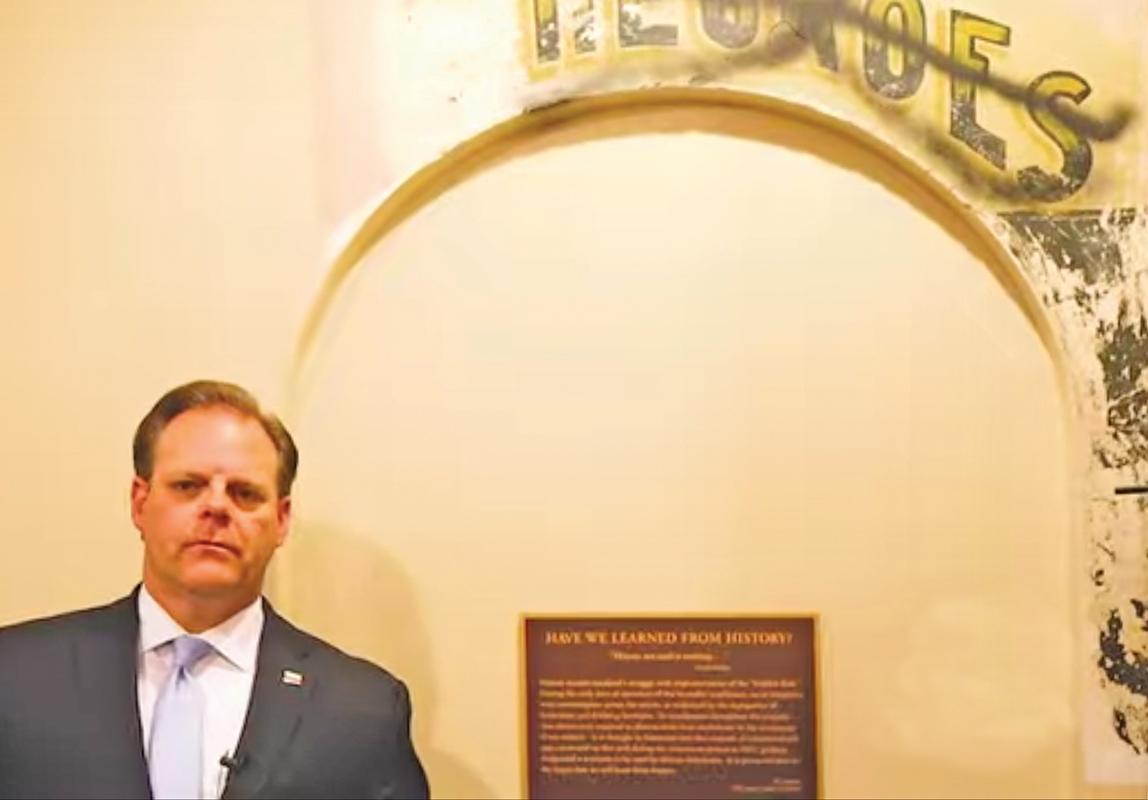
Little talks about the Ellis County office relocation and the segregation-era ‘Negroes’ sign on Nov. 17, 2020, at the Ellis County Courthouse.
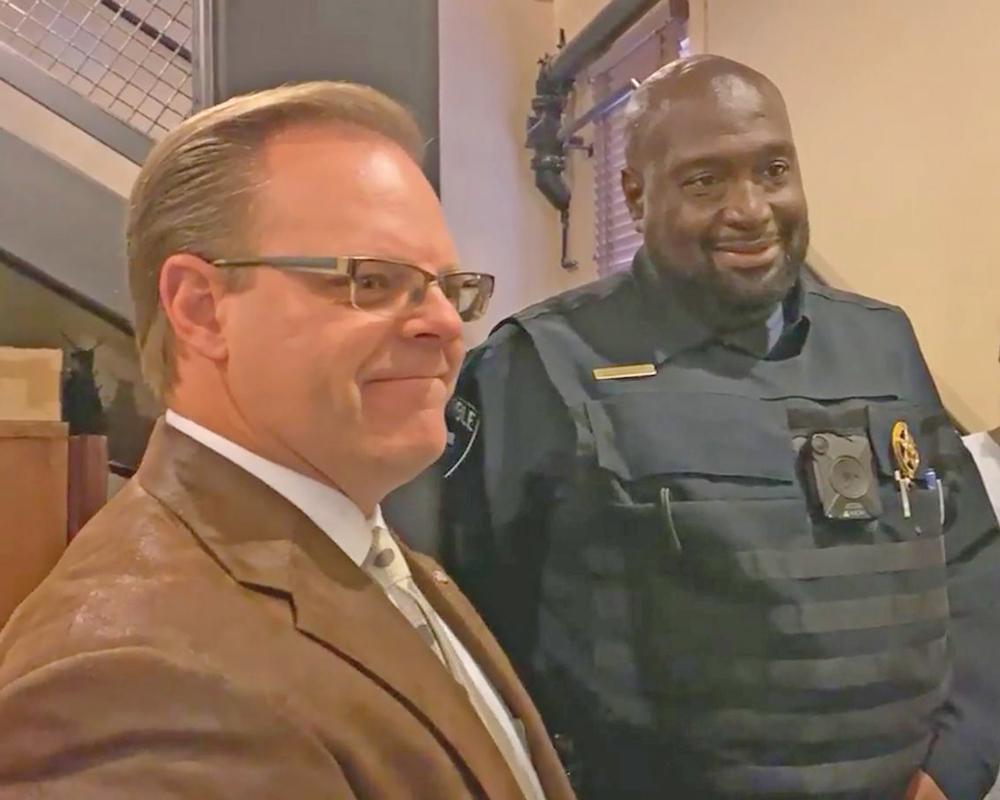
Ellis County Constable Curtis Polk, Jr., pct. 3, posted a statement on Facebook last month after a commissioner’s court vote forced him to relocate his office to the basement of the courthouse, near the sign.
Polk was later moved to a private office after the controversy broke, and now the county judge is a suspect in an act of vandalism against the sign.
According to court records, Little is a suspect, along with another man, in the defacement of the sign, which reads “negroes”.
The criminal investigation has been turned over to Dallas County District Attorney John Creuzot after Ellis County prosecutors requested an order recusing themselves, records show.
No one has been charged, and it remains under investigation.
Someone spray-painted over the sign, which hung over the spot where a water fountain once stood and was preserved as a reminder of the mistakes of the past.
The sign became the center of a controversy involving Polk, the only Black person serving in an elected county-level position, after Polk objected around mid-November to having his office moved to the courthouse basement and having to see the sign every day.
After Polk’s story spurred a rash of negative publicity, Little offered the constable a private office in the courthouse in Waxahachie to resolve the issue. Then a YouTube video surfaced, apparently showing Little urging another man, Ernest Henry Walker, to spray-paint over the sign, according to Ellis County court records.
Patrick M. Wilson, the outgoing district attorney for Ellis County, wrote in a court filing seeking a recusal that the act of vandalism, recorded by Walker and posted online, occurred on or about Nov. 17.
The graffiti was an “attempt to obliterate historic, segregation-era signage,” Wilson stated in the document.
Little is “prominently heard and seen” in the video, and he “encourages and directs” his alleged accomplice in the act of vandalism, according to the filing.
When Walker finished allegedly defacing the sign, Little told nearby Ellis County sheriff’s deputies to “stand down and take no action,” Wilson stated.
“Little could also be deemed to be a person with a legal duty to prevent the vandalism and who failed to make a reasonable effort to prevent the commission of the act,” Wilson wrote in the court filing.
Little and Walker have a “longstanding preexisting relationship,” the nature of which is unclear, Wilson wrote.
Walker could not be reached for comment.
Wilson said preliminary estimates indicate it will cost $750 to fix the damage – meaning felony vandalism charges could apply.
The county sheriff investigated the matter, and potential charges could include criminal mischief; reckless damage or destruction; or graffiti involving a public monument, court records show.
Wilson said in his motion an outside prosecutor should look into the matter to determine if criminal charges are warranted because Little has authority over his office’s budget.
Creuzot was out of town and unavailable for comment. An official from his office said he only just received the court order appointing him but has not seen the case file.
Lane Grayson, an Ellis County commissioner, said on Thursday that vandalism is not the answer.
“Any defacing of government property is an absolute insult,” he said. “That sign was left as a historical reminder of a place we should never go again.”
Grayson said the sign will be restored to its original condition and is worthy of remaining in the courthouse.
“I’m very sad that it happened, and the circumstances of how it happened,” he said. “What they did was correct in preserving that.”
The sign, which was outside Polk’s office in a stairwell he used for storage, was uncovered during courthouse renovations nearly 20 years ago. The peeling black-and-gold letters were preserved and designated with a placard below, explaining that the sign once likely designated segregated facilities for Black people.
At one point, the sign had been covered with white paper and tape.
Polk, 42, who has held the position of constable for Ellis County’s Precinct 3 since January 2019, said he decided to speak up about his move to the basement because he needed to “take a stand for myself.”
Little, a businessman in the insurance industry who has served as county judge since January 2019, said in a public video statement at the time that he believed previous Ellis County leaders preserved the sign “so the evil of requiring people of another color to drink at an alternate water fountain would never happen again.”
Little also said that if the sign was “too painful for us to view in the future, then we’re open to changing it.” Little said he’s known Polk for years and that the commissioners’ decision about office relocations to make way for a new court in the building was not meant to offend the constable. He also said there was no political or racial motivation behind the move.
- Log in or Subscribe to post comments.