
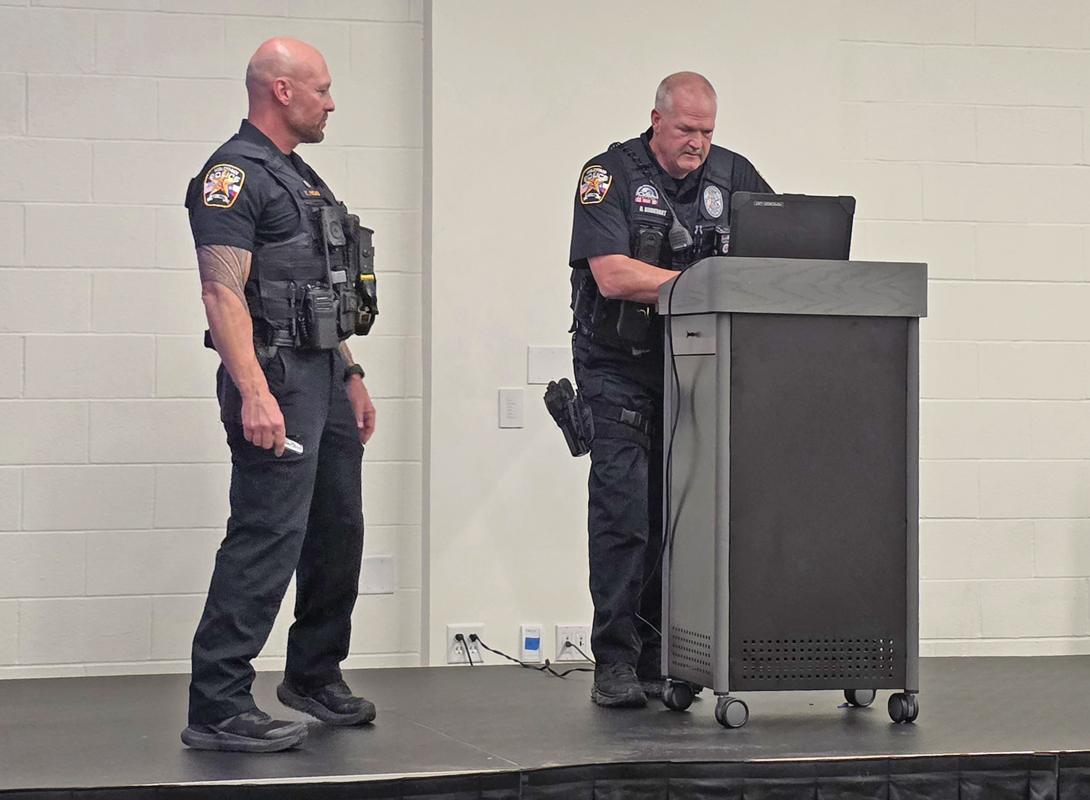
MIDLOTHIAN – This past Saturday, I attended the Midlothian Police Department’s Civilian Response to Actor Shooter Events training.
The strategy is based on the Avoid, Deny, Defend (ADD) tactic developed by ALERRT (Advance Law Enforcement Rapid Response Training) in 2004.
Training was part of a larger partnership with more than 30 local police departments in the area and the North Texas Crime Commission that held training classes with residents to ensure civilians stay aware.
The Midlothian training class was led by Midlothian Commander Timothy Hicks and Officer Darren Burkhart. Both shared anecdotes while explaining key reminders in the event of an active shooter event.
While no one wants to live in a world in which they are constantly afraid, at times a person’s ability to think quick is what saves their life.
If you are the kind of person who mingles around trying to form a consensus on whether there is danger, you are likely the one who will go down first.
Hicks and Burkhart stressed the need for immediate action.
The first option is Avoid (at one time called Run), and that means if there is a way to escape do it, immediately. While taking others with you is honorable, do not let anyone cost you your life.
It is also a good idea to always know your surroundings, identify exits, and if possible leave the area if a critical event occurs.
The next step is Deny (known in the past as Hide). Deny seems to me to be more proactive than hiding.
If escape is not an option, find a secure location. Lock or barricade doors and silence electronic devices.
The final option is to Defend (known before as Fight).
Defending is a last resort, but be prepared to protect yourself with whatever means necessary.
Be committed to take the shooter down and use whatever you must as a weapon to do it.
These days an active shooter event is considered when one or more persons is killed or there is an attempt made to kill as many people as possible in a short time.
Hicks and Burkhart explained the attacker in these incidents rarely have a profile, but often an avenger mindset.
Also discussed were the type of people waiting for someone else to take the lead in an emergency (for example running or hiding).
In other words, there is no safety in numbers because rarely do people step up. Those who do are social proof that survivors often not only take the lead, but save other’s lives as well.
There will always be the immediate adrenaline rush when in incident occurs, it is how you handle the seconds just after that for determining if you will save your life.
The two instructors pointed out that while people often believe school shootings are the number one place active shooter events occur, that is not true. Businesses are the number one location at about 47%, followed by outdoor venues at 27% and school and others coming in at 13% each.
Active shooter events in the past such as the Virginia Tech incident have also taught law enforcement new ways to improve survival rates involving these events.
Burkhart pointed out “It is no longer suggested people play dead like we had recommended in the past.”
There have been 597 active shooter events in the United States from 2000 to 2024. There were 4,055 casualties, and 1,415 dead as a result.
“We don’t want people to be paranoid to live their life,” Hicks said. “Just always be aware of your surroundings.”
- Log in or Subscribe to post comments.